
The middle layer is 50% of your transformation
What a detour into food certification taught me about ERP, monoliths, and agentic AI
I spend most of my time in Retail, Wholesale, Manufacturing, and Supply Chain. Dynamics 365, Commerce platforms, Enterprise architectures, Integration architectures — that’s my world. So when I recently took on a project in professional services — specifically in the Testing, Inspection & Certification (TIC) industry — I expected a completely different landscape.
What I found instead was remarkably familiar.
Within a day of research, I recognised the same architectural patterns, the same monolithic constraints, and the same integration challenges I’ve been solving in Retail and Manufacturing for years. And the solutions? Almost identical.
That’s worth writing about, because I think there’s a broader lesson here for anyone struggling with the question of how to make their Enterprise Architecture Agentic AI ready.
The monolith that everyone trusts
In the TIC world, certification bodies rely on a specialised ERP system to manage the full lifecycle of audits, inspections, and certifications. Think of it as the equivalent of Dynamics F&O or SAP, but built specifically for testing and certification workflows.
This system is deeply trusted. It’s the single version of the truth. It’s 100% auditable. The organisation’s accreditation depends on it. People have built their careers around it. The former CEO introduced it. It has decades of credibility.
Sound familiar? That’s exactly how enterprises describe their ERP. And for good reason — these systems are reliable, comprehensive, and proven. They earn their monolithic status through years of delivering on their core promise: be the system of record.
The problem: monoliths don’t speak event
Here’s where it gets interesting. The TIC industry is being disrupted by scheme owners — the organisations that define certification standards — launching their own modern cloud platforms with comprehensive REST APIs. These new platforms support headless execution, event-driven workflows, and full lifecycle management via API.
But the trusted monolith at the heart of the certification body? It exposes a basic CRUD API layer. No webhooks. No event notifications. No publish/subscribe. No way to say “tell me when a quote gets approved” and have the system push that notification/
And that’s a problem, because the future everyone is talking about — Agentic AI — lives and breathes on deterministic, event-driven APIs. An AI agent that needs to “check if the quote was approved, then trigger the planning workflow, then notify the auditor” cannot poll a CRUD endpoint every five minutes and hope for the best. It needs events. It needs a contract. It needs MCP.
The middle layer: where transformation actually happens
Here’s the insight I keep seeing confirmed, now across two completely different industries: the transformation isn’t in the monolith. It’s in the layer between the monoliths.
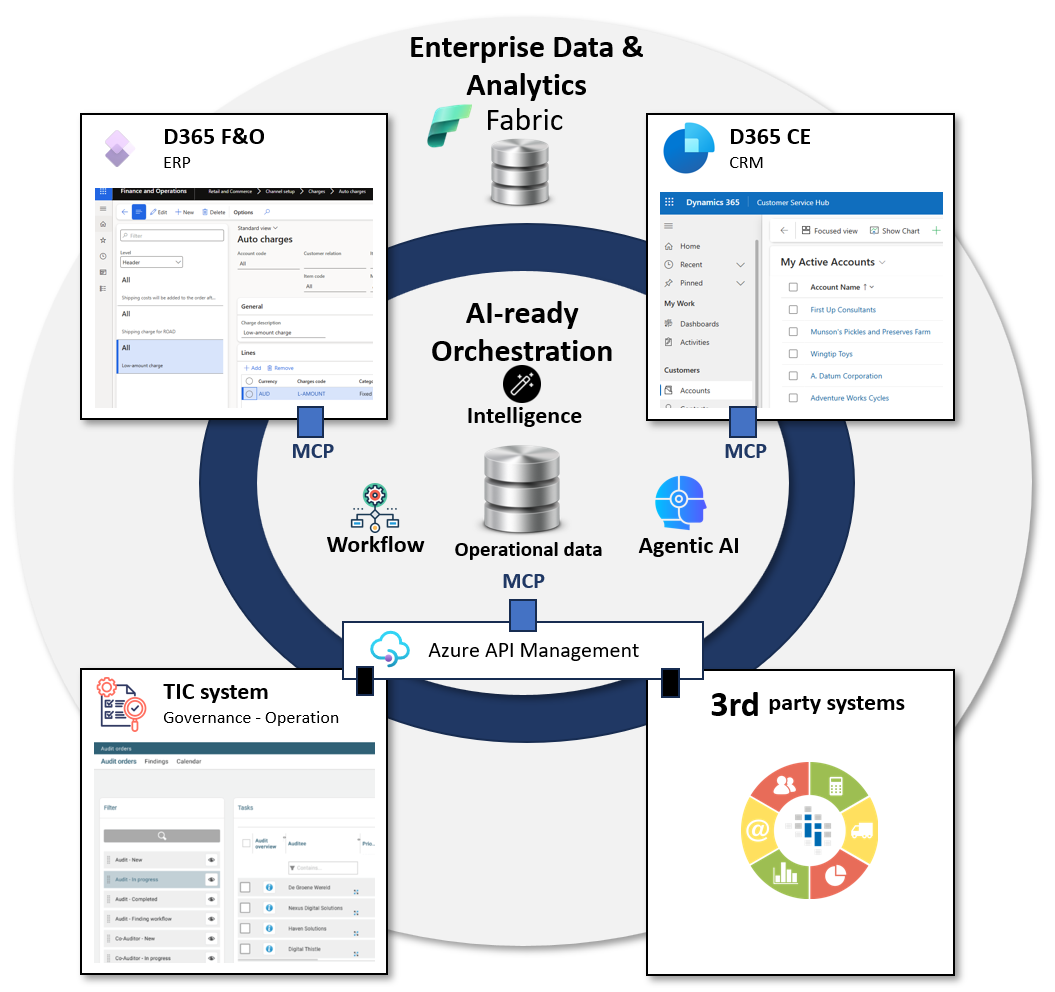
Many implementation partners still think that ERP (or TIC platform, or CRM) is 70–80% of a transformation program. My experience says it’s shifting. The middle layer — the operational data platform with workflow orchestration and AI enablement — is becoming 50% of the programme. And growing.
What does this middle layer look like in practice?
1. Data Layer: an operational database — not a data warehouse
Extract the relevant entities and status changes from the monolith on a regular schedule. Not a full canonical model for BI. Not a data lake. A focused, pragmatic operational database that stores only what’s needed for cross-system integration: business partners, work orders, approvals, key identifiers, status timestamps.
The key insight: if your monolith can’t emit events, you construct the events yourself by detecting state changes in the extracted data. A quotation that moved from “draft” to “accepted” between two extraction cycles? That’s an event. A work order that changed status from “in review” to “approved”? That’s a trigger. You don’t need the monolith to tell you — you can see it in the data.
2. Workflow Layer: a workflow orchestration layer
Logic Apps, Power Automate, Azure Functions, Service Bus — whatever your stack, the orchestration layer sits on top of the operational database and reacts to the constructed events. When it detects that a quote was approved, it calls the external platform’s API to register the client. When a certification decision is made, it pushes the outcome to the scheme owner’s registry.
This is where business process logic lives — not in the monolith (which is too rigid) and not in the external platform (which you don’t control). The orchestration layer is yours. You own it, you design it, you evolve it.
3. Action Layer: An MCP surface for agentic AI
If your monolith’s CRUD APIs are exposed through Azure API management, they can be wrapped as MCP-enabled tool endpoints. Combined with CRM, F&O, and external platform endpoints on the same gateway, you create a unified tool surface for AI agents.
Suddenly, a Copilot agent can query a client’s certification status from the TIC system, check their outstanding invoices in F&O, look up their contact history in CRM, and draft a follow-up — all through one protocol. The monolith doesn’t need to be rebuilt. It just needs to be accessible.
4. Intelligence layer: the brains for the ‘feedback loop’
Here’s where it comes together. Relevant operational data flows in, is combined with BI insights and AI powered predictive analytics, actions are distilled, and with MCP those actions are executed across systems. Collect, analyse, act — all through the middle layer.
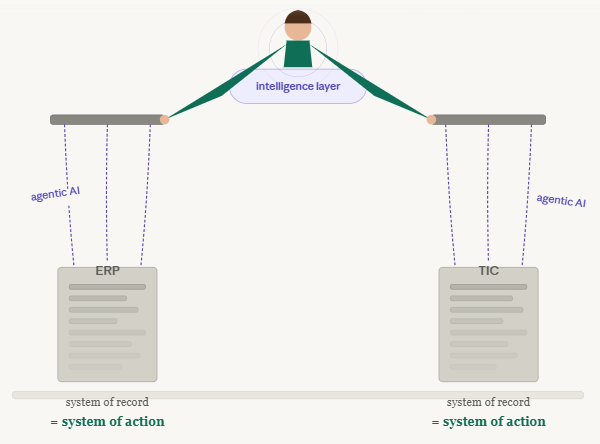
Over time, fewer and fewer employees will work in the monoliths - They operate in the middle layer instead, relying on Agentic AI being the ‘strings’ to direct the System of record ‘puppets’.
The shift: let monoliths be monoliths
I know that sounds circular, but hear me out. For decades, we’ve expected our ERP to be everything: system of record, workflow engine, reporting tool, collaboration platform, and now AI host. That’s too much weight for any monolith.
The shift I see — confirmed in retail, manufacturing, and now in TIC — is that monoliths are settling into what they’re actually good at: being the trusted, auditable, comprehensive system of record. They keep their robustness. They keep their reputation. They keep their regulatory compliance.
But the workflow-oriented tooling, the approval flows, the cross-system orchestration, the AI-enabled intelligence — that doesn’t need to be built inside the monolith. It lives in the middle layer. And increasingly, it’s the middle layer that users actually interact with day to day.
The result? Fewer users logging into ERP. Fewer users logging into the TIC platform. These systems become the trusted archive, the system of record. The middle layer becomes the operational face — where work gets done, decisions get made, and AI agents collaborate with humans.
Agentic AI acts as the strings to direct the puppets, the systems of record which now become systems of action.
Best of all worlds
This isn’t a replacement strategy. It’s an augmentation strategy. The monolith retains its strengths. The middle layer compensates for its limitations. And the organisation gets an architecture that’s ready for agentic AI without ripping out the systems everyone trusts.
I found it striking that a step into a completely different industry confirmed what I’ve been seeing in retail and commerce for years. The same monolithic patterns. The same CRUD API constraints. The same event-driven gaps. And the same solution: build the middle layer, make it intelligent, and let the monoliths do what they do best.
If your organisation is asking “how do we make our architecture agentic AI ready?” — the answer probably isn’t “replace the ERP.” or to put your software vendor under pressure. It’s build the layer between your systems. That’s where 50% of your transformation lives. And that’s where the future is being built.
—